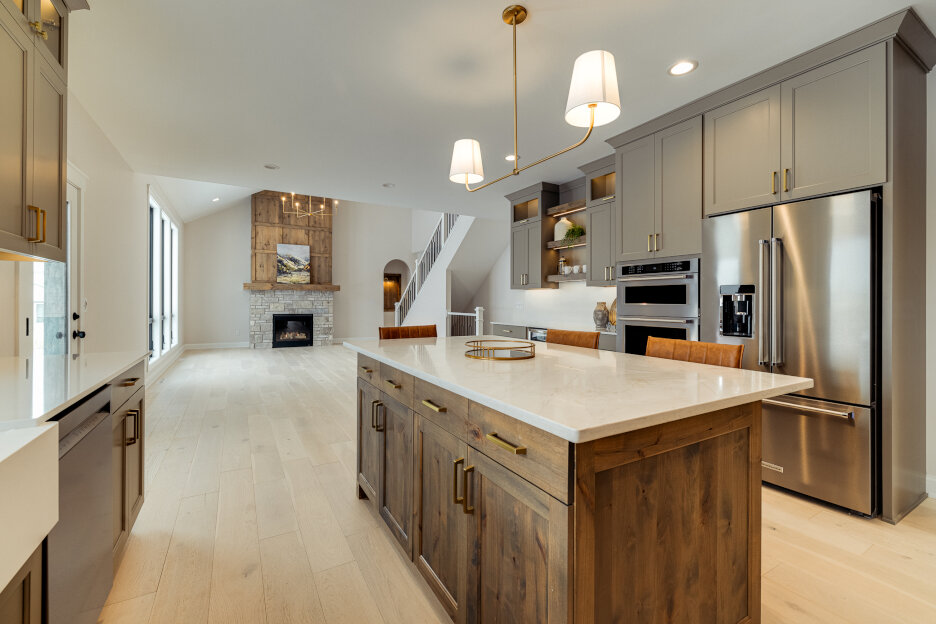
When you are deciding how to buy or build your next home in Minnesota or Wisconsin, one of the biggest questions you will face is whether to purchase a spec home or build a custom one.
Spec homes are move-in ready and feel convenient on the surface. Custom homes take more planning upfront, but for most buyers who think beyond the first year of ownership, the long-term value case for building custom is hard to argue with.
This is not about luxury for the sake of luxury. It is about making a smart, informed decision with one of the largest investments of your life.
What Is the Difference Between a Custom Home and a Spec Home?
Before comparing value, it helps to understand what each term actually means.
A spec home, short for speculative home, is built by a developer before a buyer is identified. The builder makes all the decisions about layout, finishes, and features based on what they believe will sell. You purchase the finished product, or something close to it, with limited ability to change what is already in place.
A custom home is designed and built specifically for you. You work directly with a builder and design team to determine the floor plan, materials, finishes, and features from the ground up. Every decision reflects your lifestyle, your priorities, and your budget.
The difference sounds simple. The long-term implications are significant.
Custom vs Spec Homes Summary
Spec Home
- Move-in ready
- Limited customization
- Builder-selected materials and layout
- Faster timeline
- Convenience-focused pricing
Custom Home
- Designed around your lifestyle
- Full material and layout control
- Energy efficiency built in
- Longer timeline but greater personalization
- Value driven by long-term fit
Here is where the long-term value of building custom becomes even clearer.
- You Get Exactly What You Need, Not What Someone Guessed You Would Want
Spec home builders make decisions based on the broadest possible appeal. That means neutral finishes, standard layouts, and features designed for the average buyer, not for you specifically.
A custom home is built around how you actually live. Do you need a dedicated home office? A mudroom that handles a Wisconsin winter’s worth of wet boots and gear? A kitchen layout that works for someone who actually cooks? These are decisions you make intentionally in a custom build, not compromises you accept after the fact.
Over time, a home that fits your life well requires fewer renovations, fewer workarounds, and less frustration. That functional fit has real financial value even if it does not show up on a standard appraisal.
- Material and Construction Quality Is in Your Control
In a spec home, the builder controls every material and construction decision, and those decisions are often driven by margin, not longevity. You may not know what is inside the walls, under the floors, or behind the fixtures until something goes wrong years later.
In a custom build, you choose the materials. You know what went into the home because you were part of those conversations from the beginning. A builder like Meier Design and Build brings experienced craftsmen and quality trade partners to every project, which means the construction quality reflects a standard set by the homeowner, not a production schedule.
As one of our clients, Josh R., put it: “The quality of materials are top notch.” That kind of confidence is hard to put a dollar amount on until you are fifteen years into ownership and your home still looks and functions exactly as it should.
- Energy Efficiency Can Be Built In From the Start
One of the clearest long-term financial advantages of a custom home is the ability to specify energy-efficient systems, insulation, windows, and mechanical equipment from day one.
In Minnesota and Wisconsin, where heating costs are a real part of annual household budgets, this matters considerably. A well-insulated custom home with high-efficiency HVAC, properly sealed windows, and smart mechanical systems can meaningfully reduce utility costs year over year compared to a spec home built to minimum code requirements.
With long heating seasons and fluctuating utility costs across the Upper Midwest, energy performance becomes a year-after-year financial advantage rather than a one-time upgrade.
Retrofitting an existing home for energy efficiency after purchase is expensive and disruptive. Building it in from the start is far more cost-effective and adds to the home’s resale value over time.
- You Build Equity From a Stronger Starting Point
Spec homes are priced to include the developer’s profit margin, carrying costs, and market speculation. You pay for the convenience of a finished product, and that premium is built into the purchase price from day one.
Custom homes, particularly those built on land you already own or purchase separately, often offer a stronger equity position at completion. You are paying for construction costs and builder margin, not a speculative markup based on what the market might bear.
In many cases, homeowners see stronger appraisal alignment because the home reflects current material costs and site value rather than speculative resale pricing.
In growing communities across the Upper Midwest, a well-located, well-built custom home also tends to hold its value more reliably over time. Unique, quality-built homes in established or emerging neighborhoods are consistently in demand and do not compete directly with cookie-cutter production housing in a down market.
- The Home Grows With You
Life changes. Families grow. Work situations shift. A spec home is a snapshot of what a builder thought buyers wanted at a particular moment in time. A custom home can be designed with your future in mind.
That might mean:
- A flexible bonus room that works as a playroom now and a home office later
- A main-floor primary suite for long-term accessibility
- A layout that accommodates multigenerational living, if needed
- Garage space sized for actual vehicles and equipment, not a national average
- Outdoor living areas designed for how people actually use them in the Midwest
Planning for the long term at the design stage costs far less than renovating for it later.

What the Meier Design and Build Process Makes Possible
For families across Minnesota and Wisconsin, Meier Design and Build brings more than 24 years of custom homebuilding experience to every project. The process is built around the homeowner from the very first Discovery Meeting, where Paul Meier and our team work to understand your vision, your lifestyle, and your budget before a single drawing is made.
As Shaw V. shared after working with the Meier team: “Paul worked hard to find us a floor plan that not only fit our family but also fit our budget.” That combination of personal attention and practical problem-solving is exactly what makes a custom build worth the investment.
Our team includes talented designers, experienced craftsmen, and onsite project managers who stay involved from design through closing, so the home you envisioned at the beginning is the home you move into at the end.
Build Something That Lasts
A spec home gets you into a house. A custom home gets you into your home. For Minnesota and Wisconsin families who plan to stay, grow, and invest in where they live, the long-term value of building custom is clear.
Meier Design and Build is ready to start that conversation. Schedule your Discovery Meeting today.
Frequently Asked Questions
Is a custom home always more expensive than a spec home?
Not necessarily. The total cost depends on the size, location, materials, and features involved. In many cases, a custom home on land you own can be built for a comparable or lower cost than purchasing a finished spec home — with significantly more control over what you get for your money. A Discovery Meeting with a builder like Meier is a low-pressure way to get a realistic picture.
How long does it take to build a custom home?
Timelines vary depending on the complexity of the design, permitting requirements, and site conditions. Most custom homes in the Minnesota and Wisconsin market take between eight and fourteen months from signed agreement to move-in. Your builder should be able to give you a clear project timeline before construction begins.
Do I need to own land before starting the custom home process?
Not always. Some builders, including Meier Design and Build, work with clients to identify available lots and developments as part of the early process. If you already own land, that is a strong starting point, but it is not a prerequisite for beginning the conversation.
What makes a custom home easier to resell in the future?
Custom homes built with quality materials, energy-efficient systems, and thoughtful layouts tend to appraise well and attract serious buyers. In the Upper Midwest market, a well-built custom home in a desirable location holds its value more reliably than production housing because it stands out in both quality and character.